© All rights reserved. Powered by Techronicler



Black History Month Series
In Conversation with ABIOLA OSHO
A Techronicler interview with Abiola Osho
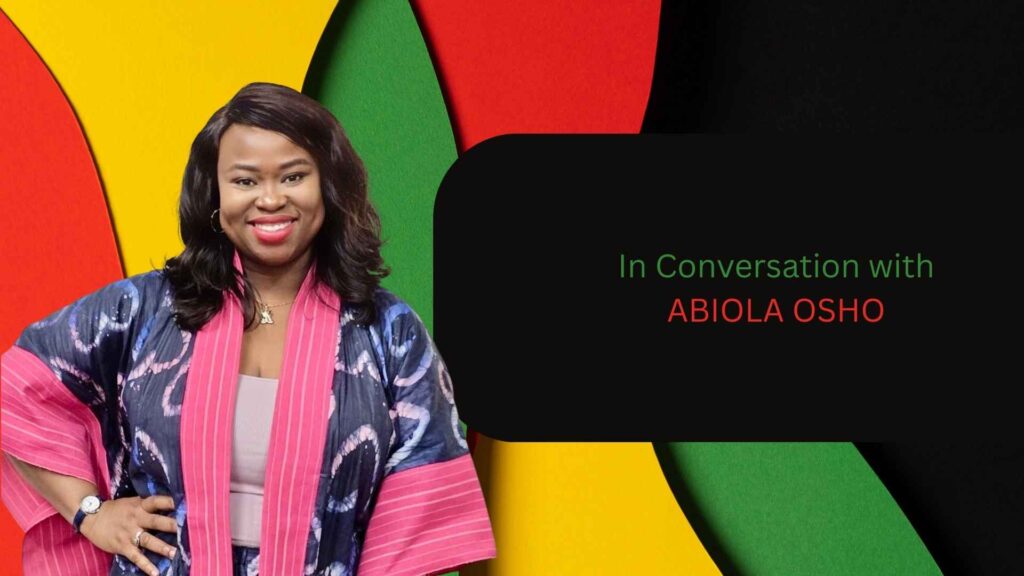
From academic research on privacy-preserving frameworks to protecting millions of transactions at JP Morgan Chase, Abiola Osho has built a career at the cutting edge of Applied AI. As Vice President and ML Lead, she leverages graph analytics and behavioral modeling to outsmart increasingly sophisticated fraud rings. For our latest Techronicler feature, we sat down with her to discuss the “why” behind the code, how she translates technical complexity into business impact, and why her non-linear journey from Nigeria to a Ph.D. in Kansas is her greatest asset.
Techronicler:
Please share with our readers your experience in tech + what you currently do for work (and passion projects)!
Abiola Osho:
My journey in tech has taken me from Nigeria to the United States, where I earned my Ph.D. in Computer Science from Kansas State University. Today, I serve as Vice President and Applied AI & ML Lead at JP Morgan Chase, where I lead the development and deployment of machine learning models that protect millions of customers from fraud and scams across our digital payment channels.
My work sits at the intersection of applied AI, graph analytics, and behavioral modeling. I’m particularly fascinated by how we can use machine learning to understand complex patterns in financial transactions. This includes building graph structures that capture relationships between accounts, using large language models to extract fraud indicators from unstructured data, and creating systems that adapt in real-time to evolving threats.
Before joining Chase full-time, my research focused on online safety and privacy preservation on social platforms like Twitter. I developed systems to identify users vulnerable to abuse and misinformation, and created privacy-preserving frameworks that protect people while maintaining platform functionality. This work taught me that the most impactful technology serves people. It keeps them safe, protects their privacy, and earns their trust.
Beyond my day job, I’m deeply passionate about two areas. First, mentoring high school students in career navigation. I believe in demystifying tech careers early and helping young people, especially those from underrepresented communities, see themselves in these roles before they reach college. There’s something powerful about showing a teenager that the path to tech isn’t linear, that your background is an asset, and that the field needs their unique perspective. Second, I’m involved in cyber safety initiatives where I focus on helping people stay safe online. This work stems directly from my Ph.D. research on privacy preservation and protecting vulnerable users from abuse and misinformation on social platforms.
Techronicler:
What problem are you most excited to be working on right now?
Abiola Osho:
The ability to translate between technical complexity and business impact has been my most valuable skill. As much as I love the technical depth (the algorithms, the model architectures, the data pipelines), the real value comes from understanding the why behind what we’re building.
Early in my career, I focused heavily on technical excellence. I could build sophisticated models, optimize performance metrics, and publish research. But I learned that sustainable impact requires bridging worlds: understanding how fraud investigators actually work, what keeps product managers up at night, why engineers make certain infrastructure decisions, and how regulatory requirements shape what’s possible.
This skill has been crucial in my leadership role. When I’m working with my team, we’re not just improving AUC scores. We’re thinking about how a model will perform in production, how it integrates with existing systems, how its outputs are interpreted, and how it aligns with our risk appetite. When I’m presenting to senior leadership, I’m translating model performance into business outcomes: detection rates, false positive impacts, and customer experience implications.
I think this translation skill is particularly important for Black women in tech. We often find ourselves as bridges between technical and non-technical stakeholders, between innovation and practicality, and between what’s theoretically possible and what’s organizationally achievable. Leaning into that role, rather than seeing it as an extra burden, has accelerated my growth.
Techronicler:
What skill has been most important to your growth in tech so far?
Abiola Osho:
First, your perspective is not a liability. It’s a superpower. The experiences that make you different are exactly what tech needs. Whether it’s understanding communities that are often overlooked in product design, bringing cultural context to behavioral modeling, or asking questions others don’t think to ask, your unique viewpoint creates better solutions.
Second, build your technical foundation deeply, but don’t wait for perfection before stepping into leadership or visibility. I see too many brilliant Black women holding themselves back because they feel they need one more degree, one more certification, one more year of experience. Meanwhile, others with half the qualifications are confidently stepping forward. Be rigorous in your learning, but also be bold in claiming your expertise.
Third, find your people and be intentional about it. Mentorship changed my trajectory, thanks to organizations like blackcomputeHER and Rewriting the Code. Now I’m committed to being that for others. Seek out people who’ve walked similar paths, but also build relationships across differences. Some of my valuable mentors don’t look like me, and some of my mentees have backgrounds completely different from mine. It’s the constellation of perspectives that makes you whole.
Fourth, remember that impact takes many forms. Not everyone needs to be a VP or CTO. Whether you’re building products, conducting research, teaching, or creating systems that millions depend on, if your work matters to you and serves others, that’s success. Don’t let anyone else define what achievement looks like for you.
Finally, when you make it through a door, hold it open. Even as you’re still figuring things out yourself, there’s someone behind you who needs to see that it’s possible. Mentor a high schooler. Speak at your local university. Volunteer at your time and skills. Share your journey honestly, including the struggles. Representation matters, but accessible representation matters even more.
Techronicler:
What is some advice you want to give to other young women in the industry Black women entering the tech space? / What advice would you give to your younger self entering tech?
Abiola Osho:
The advice I would give to myself, four or five years ago, would be to not rush and enjoy learning slowly and enjoy the moment where you are now. I wanted to have the job that everyone said I was supposed to have yesterday, but slowing down and enjoying my work has opened up so many more possibilities for me that I could never have imagined, but they fit me perfectly. I would also tell myself that you’re still learning but you are brilliant and meant to be in the job– you’re not an imposter, just a new fish in the pond still learning to swim. Give yourself grace.
Techronicler:
What do you want people to understand about Black women in tech that often gets missed?
Abiola Osho:
We’re not a monolith, and we’re tired of being treated as the ‘diversity initiative.’ We’re here because we’re excellent, because we bring skills and perspectives that make products better and companies more successful. Too often, our presence is framed as charity or quota-filling rather than what it actually is: a competitive advantage for any organization smart enough to recognize it.
What often gets missed is the weight we carry that others don’t see. There’s the technical work, which is hard enough. But then there’s also being hypervigilant about mistakes, managing perceptions, navigating microaggressions, code-switching, mentoring others while still figuring things out ourselves, and carrying the responsibility of representation. Every success or failure feels amplified because we know we’re often the only Black woman in the room, and people are watching.
I also want people to understand that our path to tech leadership is rarely linear. Many of us came to this field through unconventional routes, supported ourselves through school, juggled family responsibilities, or navigated immigration systems. I moved from Nigeria to pursue my education, worked through a Ph.D. while building my technical foundation, and had to learn not just the technical skills but also how to operate in American corporate culture. That circuitous journey isn’t a weakness. It builds resilience, adaptability, and creative problem-solving that serves us incredibly well in leadership.
Finally, I want people to understand that when we advocate for ourselves or others, we’re not being difficult. We’re being strategic. We know what systemic barriers look like because we’ve navigated them. When we ask for transparent promotion criteria, equitable pay, inclusive team cultures, or diverse candidate pools, we’re not asking for special treatment. We’re asking for the same conditions that allow everyone to thrive, and we’re often the first to notice when those conditions are missing.
Techronicler:
Your mentoring journey is inspiring. Please share some insights about this journey you’re on.
Abiola Osho:
It’s important for us to understand why early intervention in career navigation is crucial. By the time students reach college, many have already internalized messages about who belongs in tech and who doesn’t. High school is when we can interrupt those narratives.
When I work with high school students, especially young Black girls, I’m not just teaching them about algorithms or Python. I’m showing them that someone who looks like them has earned a Ph.D., leads teams at a major financial institution, and believes they can do the same, or better. I’m helping them understand that tech careers are diverse: you can do research, build products, lead teams, start companies, or create social impact. The path is wide, and there’s room for their dreams.
I also focus on practical navigation: how to think about college choices, how to build a network even when you don’t come from a connected family, how to find internships, how to ask for help, and how to bounce back from rejection. These are the things that often make the difference between potential and actualization.
Every time a young person tells me they’re now considering computer science, or that they didn’t know Black women could be VPs at tech companies, or that they’re going to apply for that internship they thought they weren’t qualified for, that’s when I know the work matters. Because the tech industry won’t truly change until we change who feels entitled to enter it in the first place.
“Your perspective is not a liability. It’s a superpower.” Abiola’s insights remind us that true innovation happens when we bridge the gap between advanced algorithms and human needs. Whether she is dismantling fraud networks or dismantling barriers for high school students entering tech, her impact is profound. We thank Abiola for sharing her expertise and her unwavering commitment to “accessible representation.”
If you wish to showcase your experience and expertise, participate in industry-leading discussions, and add visibility and impact to your personal brand and business, get in touch with the Techronicler team to feature in our fast-growing publication.
Individual Contributors:
Answer our latest queries and submit your unique insights:
https://bit.ly/SubmitBrandWorxInsight
Submit your article:
https://bit.ly/SubmitBrandWorxArticle
PR Representatives:
Answer the latest queries and submit insights for your client:
https://bit.ly/BrandWorxInsightSubmissions
Submit an article for your client:
https://bit.ly/BrandWorxArticleSubmissions
Please direct any additional questions to: connect@brandworx.digital