© All rights reserved. Powered by Techronicler



The New Rules of AI
6 Essential Books for Working and Winning in the Age of Intelligent Machines
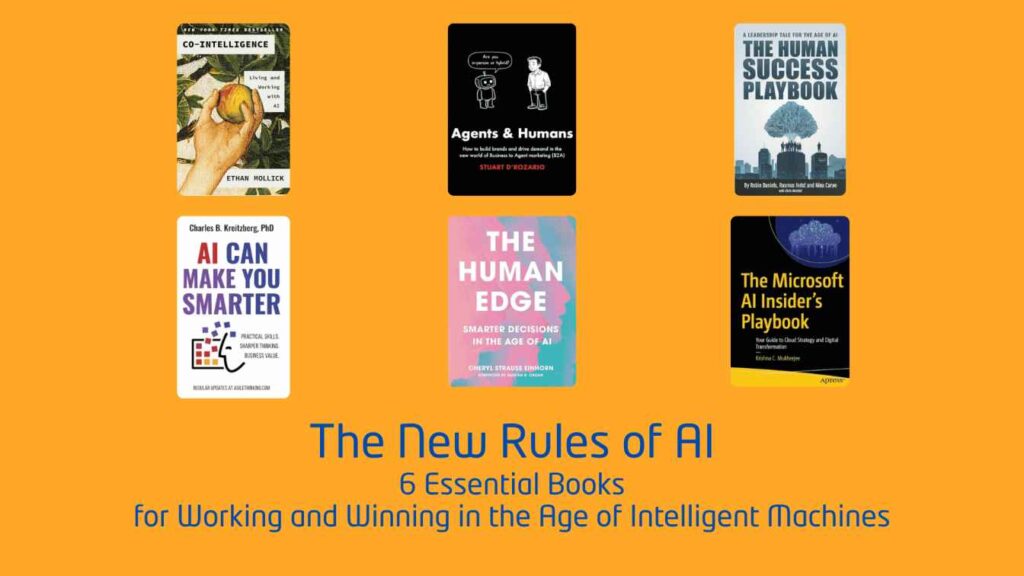
Artificial intelligence has stopped being a someday story and become a right-now one. It is already drafting our emails, researching our purchases, sitting in on our decisions, and quietly reshaping how customers find the brands they trust. The question is no longer whether to pay attention, but how to work with these tools instead of being left behind by them. The six books on this list approach that challenge from different angles—sharper everyday skills, smarter decisions, stronger leadership, better marketing, and enterprise strategy—but they share one grounding belief: AI works best when it makes people more capable, not less. Together they offer a clear, practical map for anyone trying to turn the hype into a genuine human edge.
This instant New York Times bestseller has become the go-to playbook for making sense of the AI moment. Ethan Mollick, a Wharton professor and author of the popular One Useful Thing newsletter, cuts through both the hype and the doom to offer something more useful: a practical guide to actually living and working with these tools. His core advice is to invite AI to the table and treat it as a co-worker, co-teacher, and coach rather than a threat or a magic box. Drawing on his own research and countless real examples, Mollick shows how AI can amplify what people do best while being honest about its flaws and limits. Warm, clear, and optimistic, it’s the ideal starting point for anyone who wants to understand how this technology will change the way we work and think.
Many people quietly worry that leaning on AI will make them lazier thinkers. Charles Kreitzberg makes the opposite case, but with an important catch: AI only makes you smarter if you use it thoughtfully. A cognitive psychologist and UX pioneer who founded the design consultancy Cognetics and advises Princeton, Kreitzberg brings six decades of thinking about how technology can enhance the human mind. His book is a hands-on toolkit of more than two dozen techniques for writing, brainstorming, problem-solving, learning, project management, and preparing for high-stakes conversations. Each one stands on its own, so readers can dip in wherever they need help today. Throughout, he insists on a human-centered approach: try the task yourself first, then use AI to sharpen it, keeping you firmly in control and responsible for the result. It’s a reassuring, immediately useful guide for anyone who uses a computer at work.
Cheryl Strauss Einhorn has spent her career teaching people how to make better, less biased decisions, and here she turns that expertise to the age of AI. Her argument is reassuring: even when AI does the heavy lifting, deciding remains a deeply human act, and you should stay in the driver’s seat. Built on her proven AREA Method and practical “Cheetah Sheets,” the book offers a clear framework for defining a problem, weighing motivations, analyzing information, and guarding against the biases that trip us up—while using AI to research and pressure-test along the way. She’s candid about AI’s limitations and methodical about how to manage them, bringing it all to life with vivid real-world stories. Published in association with Cornell University Press and opening with a foreword by tech leader Marian Croak, it’s an essential guide for anyone who wants AI to enhance their judgment rather than replace it.
Most books about AI focus on the technology. This one focuses on the people who work alongside it. Told as an engaging business fable, The Human Success Playbook follows leaders wrestling with the question every executive now faces: are you scaling software, or are you scaling humans? Robin Daniels and Rasmus Holst blend Silicon Valley ambition with the Scandinavian idea of tryghed—a deep sense of security—to argue that engagement, learning, and performance form one connected system they call “The Trifecta.” They introduce the rising role of the “Human Success Officer” and make the case that the smartest response to AI is to invest more in people, not less. Easy to read and full of heart, it’s a welcome reminder that in an automated world, human culture is the real competitive advantage.
Here’s a shift most marketers haven’t fully grasped yet: your brand now has two audiences, and one of them isn’t human. Award-winning ad man Stuart D’Rozario—a Cannes Grand Prix winner and CEO of D’Rozario & Partners—argues that AI agents are quietly becoming the researchers, gatekeepers, and recommenders who decide which brands ever reach a person at all. His answer is a new discipline he calls Business to Agent marketing, or B2A. In short, punchy chapters laced with humor and cartoons, he explains how agents “think” (they love credible, structured facts and distrust flashy advertising), and lays out practical frameworks for winning their trust while still moving human hearts. It’s a smart, refreshingly readable field guide to marketing in a world where the first sales call increasingly happens inside a chatbot.
To understand where AI is taking business, it helps to learn from someone who helped build it. Krishna C. Mukherjee has been a Microsoft insider since 1988, working on the intelligent features—like AutoCorrect and the original Office Assistant—that put everyday AI into millions of hands long before the current boom. In this comprehensive guide, he demystifies cloud strategy and digital transformation for leaders who need to make smart decisions without a computer science degree. Mukherjee translates decades of frontline experience into a practical roadmap: how to think about AI adoption, where the real returns come from, and how to modernize an organization without losing sight of the people it serves. Authoritative yet accessible, it’s a trustworthy guide for any executive trying to separate AI’s genuine promise from the noise.