© All rights reserved. Powered by Techronicler



Women's History Month
In Conversation with
BETH WORTHY
A Techronicler interview with Beth Worthy, President of GMR Transcription
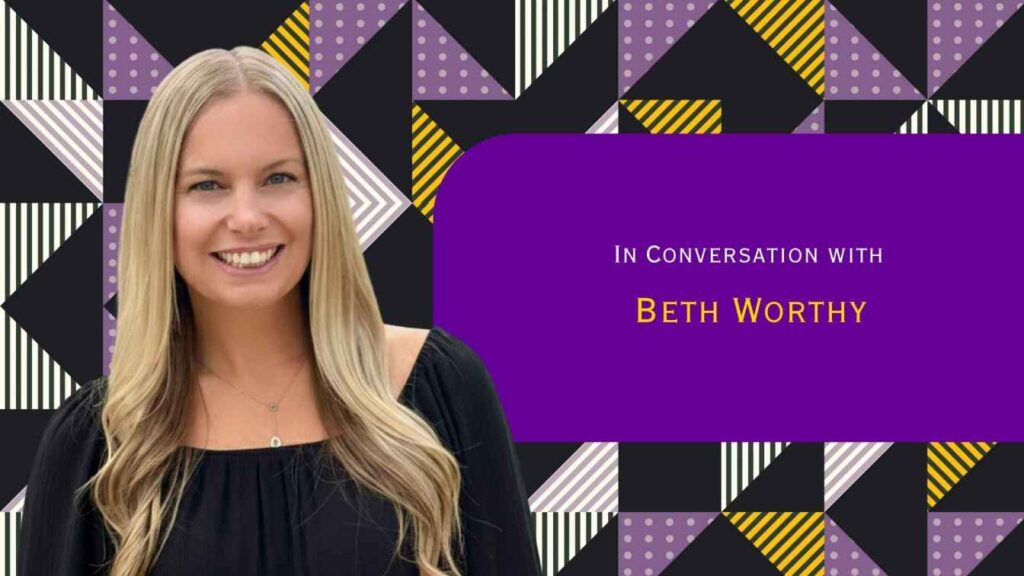
In a tech landscape currently obsessed with generative speed, Beth Worthy, President of GMR Transcription, is a vital advocate for a different metric: reliability. Her career is a testament to the idea that data is only as powerful as it is accurate. From her childhood fascination with cassette recorders to leading a premier transcription and translation firm, Beth has spent decades at the intersection of human language and digital structure.
Beth’s leadership style is rooted in the “real-world application” of tech. She has navigated the high-stakes demands of legal, research, and investigative professionals, where a single misinterpreted word can alter an entire outcome. In an era where many are rushing to “fully automate” everything, Beth has made the bold—and sometimes unpopular—call to prioritize human-centered precision over raw processing speed.
As we continue our Women’s History Month series on Techronicler, we spoke with Beth about the “Inference Economics” of 2026, why she values “real-world problem solving” over abstract hiring tests, and why she believes clarity is the ultimate negotiation tactic.
Techronicler: Thank you for joining us, Beth! Everyone has an origin story! What was the first piece of technology you ever broke, built, or fell in love with?
Beth Worthy:
I was fascinated by cassette recorders growing up. I used to record conversations, rewind them, and try to write everything down. That curiosity about capturing spoken words accurately never really left. It shaped how I think about information today. What people say often carries nuances that get lost unless someone takes the time to listen and document them truly.
Techronicler: A lot of careers look like straight lines on LinkedIn. How was yours different?
Beth Worthy:
My path developed through exposure rather than planning. Working closely with clients across industries showed me how differently people use recorded information. A turning point came when I realized transcription was not just administrative work. It directly influenced decision-making, research outcomes, and even legal clarity. That shifted how I approached the work and where I focused my efforts.
Techronicler: What is the one problem or project that is taking up 80% of your brain space this month?
Beth Worthy:
Balancing speed with accuracy at scale. There is constant pressure to process information faster, but quality cannot drop. The challenge is designing workflows in which efficiency supports accuracy rather than undermining it.
Techronicler: Tell us about a time you had to make a deeply unpopular technical decision that turned out to be the right call.
Beth Worthy:
We once had to step back from adopting a fully automated workflow that looked promising on paper. It created inconsistencies in complex audio scenarios. The pushback came from teams expecting a faster turnaround. We focused on long-term reliability instead of short-term speed. Over time, clients noticed the difference in quality, and that validated the decision.
Techronicler: From your seat, how do you see the rise of AI tools changing the trajectory for women entering engineering today?
Beth Worthy:
AI lowers the barrier to entry in some ways. It gives more people the ability to experiment, build, and understand systems without deep specialization early on. At the same time, it increases the importance of judgment. Knowing when outputs are reliable and when they need human intervention becomes a critical skill. That creates space for more diverse strengths to matter in engineering roles.
Techronicler: What is the single best piece of advice you’ve ever received about negotiating?
Beth Worthy:
Clarity wins negotiations. When you understand the value you bring and the outcome you need, conversations become more straightforward. Preparation matters more than persuasion.
Techronicler: What is the one book every woman in tech should read this year?
Beth Worthy:
Thinking, Fast and Slow by Daniel Kahneman. It helps you understand how decisions are made, which is useful whether you are building systems, leading teams, or evaluating outcomes.
Techronicler: What is a piece of ‘common wisdom’ in the tech industry that you completely disagree with?
Beth Worthy:
The idea that faster always means better. Speed matters, but accuracy and context determine whether something is actually useful. Technology should support better decisions, not just quicker outputs.
Techronicler: If you could change one thing about how we interview and hire in tech to make the process more equitable, what would it be?
Beth Worthy:
Shift more weight toward real-world problem-solving rather than abstract assessments. Give candidates scenarios that reflect actual work and evaluate how they think through them. That approach surfaces practical ability and reduces bias tied to background or test performance.
Techronicler: The ‘broken rung’ is a bigger obstacle than the glass ceiling. How are you personally helping junior women make that leap?
Beth Worthy:
I focus on exposure and responsibility early. Giving someone ownership of a small but meaningful decision builds confidence quickly. Mentorship works best when it includes real accountability, not just advice.
Beth’s insights serve as a necessary recalibration for the industry. Her perspective reminds us that while AI may lower the barrier to entry, it simultaneously raises the stakes for human judgment. By focusing on “exposure and responsibility” for junior women and resisting the “faster is better” fallacy, she is building a blueprint for leadership that values long-term trust over short-term metrics.
A sincere thank you to Beth Worthy for joining us. Her journey from capturing nuances on a cassette tape to scaling global data workflows reminds us that in the world of tech, the most important component will always be the human ear.

Beth Worthy is the President of GMR Transcription, where she focuses on building human-centered workflows for accurate, secure, and scalable transcription services. With years of experience working alongside researchers, legal teams, and investigative professionals, she brings a practical understanding of how spoken information becomes structured, usable data. Her work sits at the intersection of language, technology, and operations, with an emphasis on reliability, clarity, and real-world application.