© All rights reserved. Powered by Techronicler



Women's History Month
In Conversation with
Orad Eldar
A Techronicler interview with Orad Eldar
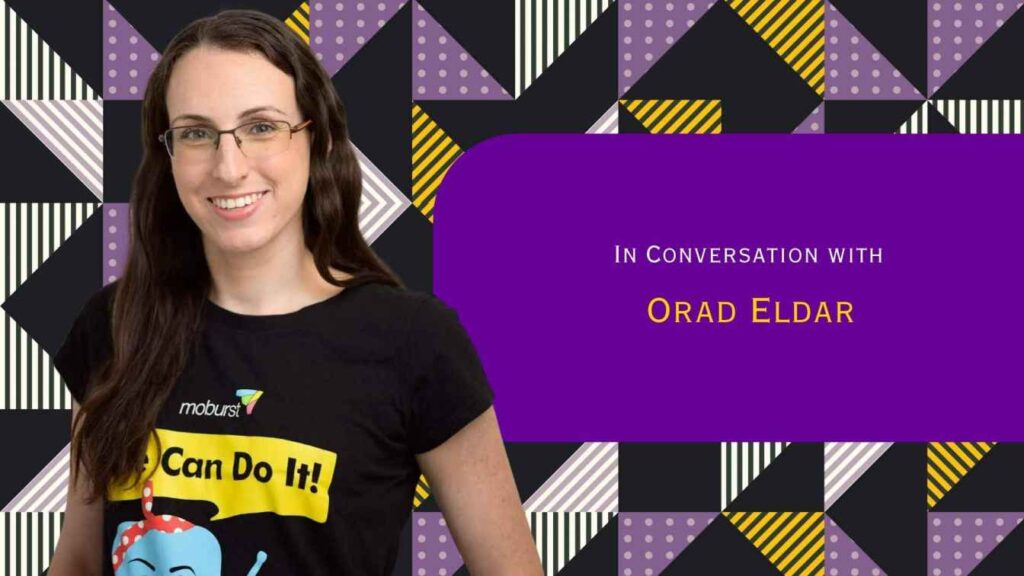
Welcome back to our Women’s History Month series. Today, we are exploring a career path that is anything but a straight line.
Our guest is Orad Eldar, VP of Media at Moburst, who proves that the most powerful “happy accidents” happen when curiosity meets discipline. Orad originally set her sights on political marketing, but a pivot into performance marketing revealed a different kind of intensity—one fueled by behavioral economics, data science, and real-time strategic decision-making.
Orad has spent her career building departments from the ground up, even launching her own bootcamps to fix the “broken rung” of leadership for junior talent. Today, she’s focused on the next frontier: architecting media systems that blend AI-powered optimization with human-led creativity.
Join us as Orad shares her perspective on leading through complexity.
Techronicler: Thank you for joining us, Orad! A lot of careers look like straight lines on LinkedIn. How was yours different? Was there a pivotal moment or ‘happy accident’ that actually steered you toward your current role or niche?
Orad Eldar:
My career definitely wasn’t a straight line! I completed a Master’s degree in Political Marketing because, for as long as I can remember, I thought I would go into political communications or spokesperson work. When people asked what I wanted to be when I grew up, the answer felt obvious: political marketing.
At the time, I saw paid media as just another tactical tool within a broader communications strategy. I didn’t yet understand how powerful – or complex – it really was.
In one of my early roles, I was exposed to performance marketing at a much deeper level. I realized it wasn’t just about buying ads. It was psychology, behavioral economics, messaging, data science, and real-time strategic decision-making combined. It had the intensity of a political campaign, but with immediate feedback loops.
I started in the field in a junior role and grew step by step – learning, testing, leading teams, building training programs, and eventually overseeing entire departments. The evolution wasn’t planned from day one. It was built through curiosity, discipline, and a constant desire to understand how systems really work. Reaching an executive role wasn’t a single leap – it was the result of compounding growth over time.
Techronicler: What is the one problem or project that is taking up 80% of your brain space this month?
Orad Eldar:
Right now, I’m focused on how AI reshapes media leadership – not just campaign execution. The real question isn’t “How do we automate?” It’s “How do we architect smarter systems?” I’m thinking about how to build media departments that combine human strategic thinking with AI-powered optimization, while maintaining creativity and accountability. It’s less about tools and more about redesigning how teams operate.
Techronicler: Many women still find themselves as the ‘Only’ (only woman, only WOC) in the room. When that happens now, how do you use that visibility to your advantage rather than letting it be a weight?
Orad Eldar:
Earlier in my career, being “the only” felt heavy. Now, I see it as leverage. If I’m the only woman in the room, I automatically represent a perspective others might not consider. I ask different questions. I’m bringing a more creative angle. I challenge assumptions around audience behavior, messaging tone, or risk tolerance. Visibility becomes influence when you’re prepared. The key is grounding your voice in data and clarity – confidence tends to follow preparation.
Techronicler: Are women in leadership still penalized for being too direct or ‘sharp-elbowed’? Have you ever had to consciously unlearn the habit of being ‘too nice’ or ‘accommodating’ to get a project across the line?”
Orad Eldar:
Yes, I think the double standard still exists. Directness in men is often labeled as decisiveness; in women, it can sometimes be interpreted as aggressiveness, or just being “emotional”. Early in my career, I was very aware of that perception, and I probably overcorrected by softening my tone or over-explaining my reasoning.
Over time, I realized the issue isn’t about being “nicer” or “sharper.” It’s about being clear. Clarity is a leadership responsibility. When you’re accountable for results, ambiguity is more damaging than discomfort.
What I’ve unlearned is the need to cushion every decision. You can be respectful and still firm. You can invite collaboration and still set boundaries. Today, I focus on being transparent, data-driven, and intentional. When decisions are grounded in strategy and aligned with business impact, confidence becomes less about tone and more about substance.
Techronicler: From your seat, how do you see the rise of AI tools changing the trajectory for women entering engineering today?
Orad Eldar:
AI lowers the barrier to entry in meaningful ways. You don’t need to know everything to start building. That can be incredibly empowering for women who may hesitate to enter spaces where they feel underrepresented. At the same time, AI doesn’t replace judgment. It amplifies it. The advantage will go to those who combine technical literacy with critical thinking and strategic decision-making. That’s an opportunity, not a threat.
Techronicler: What is the single best piece of advice you’ve ever received about negotiating—whether for salary, headcount, or project timelines?
Orad Eldar:
Negotiate from business impact, not emotion. The strongest negotiations I’ve had – whether for budget, headcount, or timelines – were grounded in outcomes. When you anchor the conversation in value creation and measurable impact, it shifts from “asking for more” to “investing for better results.” That reframing changes the dynamic entirely.
Techronicler: The ‘broken rung’ (the first step up to manager) is a bigger obstacle than the glass ceiling. How are you personally helping junior women make that specific leap from individual contributor to lead?
Orad Eldar:
I focus heavily on structured development. Earlier in my career, I built a two-month bootcamp designed to train junior team members with no PPC experience and give them both technical foundations and strategic thinking tools. What started as an experiment became a long-term program we continued running for years because it consistently worked. The structure, mentorship, and exposure to real responsibility proved transformative. Three of the juniors who went through that program eventually grew into team leadership roles themselves. That’s what closing the “broken rung” looks like to me – creating systems that build confidence, competence, and momentum early on.
Today, I’m intentional about giving emerging leaders ownership early – presenting to clients, running internal discussions, and managing smaller teams. Confidence often follows exposure. My role is to create safe environments where women can stretch before they feel fully “ready.”
“Clarity is a leadership responsibility.”
That insight from Orad Eldar is a masterclass in modern management. From her refusal to “cushion” decisions to her commitment to negotiating based on business impact rather than emotion, Orad’s approach is a roadmap for any leader navigating the double standards of the corporate world.
What stands out most is her dedication to creating systems—like her two-month bootcamps—that allow others to stretch before they feel “ready.” It’s a powerful reminder that we don’t just find leaders; we build them through structure and exposure.

Orad Eldar currently serves as VP of Media at Moburst, a leading mobile-first digital agency. With over 12 years of experience in performance marketing, she leads global paid media strategy across app, web, and multi-platform ecosystems. She specializes in scaling high-growth brands through AI-powered marketing, full-funnel media planning, and data-driven optimization. She works with both startups and enterprise companies to transform media into a strategic growth engine, bridging day-to-day performance execution with long-term business impact.